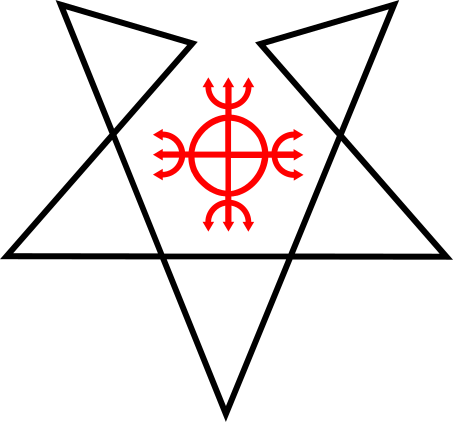

Exu
Exu (pronounced Eshu, /ˈɛʃuː/) is one of the most complex, central, and frequently misunderstood concepts within Afro-diasporic religions and African-derived occult systems in Brazil. The term designates distinct realities depending on context: it may refer to a foundational Òrìṣà of the Yorùbá system (Èṣù), to spiritual entities known as Exus (in Umbanda and especially in Kimbanda), or to a specific ontological category within contemporary initiatory systems.
Exupedia adopts a comparative, historical, and ontological approach, clearly distinguishing between these conceptual layers.
|
| |
| Field | Description |
|---|---|
| Nature | Spiritual entity / cosmological principle (varies by tradition) |
| Domains | Crossroads, passage, communication, decision-making, opening of paths |
| Systems | Ifá / Òrìṣà · Umbanda · Kimbanda · O∴S∴ Ontology |
| O∴S∴ Category | Powerful Dead One (Nkulu), liminal operator and agent of the opening of the Klipá |
| Related terms | Pombagira · Kimbanda · Ifá · Kalunga · Crossroads · Daemon · Klépoth |

General definition
In broad terms, Exu is a liminal entity or principle, associated with communication between domains, the circulation of forces, the opening of paths, and mediation between distinct orders of reality. It is not a moral figure in the Christian sense, nor a “demon” in the European theological sense, although it has frequently been demonized by colonial interpretations.
Depending on the tradition:
- Exu may be a primordial Òrìṣà (Èṣù);
- It may be a Powerful Dead One (Exu Nkulu);
- It may designate lines and phalanxes of spiritual entities with specific functions;
- It may act as the Tutelar Exu / Tutelar Pombagira (personal tutelage and operative axis of the initiate, in strands of Kimbanda).
Polarity: Exu (solar/masculine) and Pombagira (lunar/feminine)
In a large portion of Afro-Brazilian literature and ritual practice (especially within branches of Umbanda and Kimbanda), an operational and symbolic distinction is established:
- Exu — masculine and solar pole;
- Pombagira — feminine and lunar pole, often referred to as “Female Exu” (Exu Mulher).
This is a symbolic and operative classification, used to organize ritual functions, and not a biological or moral distinction.
Fundamental distinction: Èṣù Òrìṣà ≠ Exu Nkulu
An essential distinction exists between Èṣù, the Òrìṣà of the Yorùbá system, and the concept of Exu Nkulu, whose origin lies in Bantu-Kikongo Cosmology and in the Kikongo classification of operative dead.
While Èṣù is a primordial Òrìṣà, a non-human cosmological principle that precedes death, Exu Nkulu derives from the Bantu category of Nkulu (Powerful Dead One), that is, a post-mortem human spirit that attained sovereign status, capacity of governance, and operative function. In Afro-Brazilian traditions—especially within Kimbanda—this Bantu-Kikongo foundation was reinterpreted, ritualized, and named Exu.
Exu Nkulu (Powerful Dead One)
In Bantu-Kikongo Cosmology and, by historical derivation, in Afro-Brazilian traditions such as Kimbanda and in the ontology of the O∴S∴, Exu is understood as an Nkulu (Powerful Dead One): a human spirit who, after death, was recognized and stabilized through initiatory work, acquiring ritual identity, cosmological function, and operative capacity.
In the ontological vocabulary adopted by Exupedia, the term “Powerful Dead One” applies exclusively to the dead who have attained the level of Nkulu or higher. Earlier states of the post-mortem condition — even when spiritually active — are not classified as Powerful Dead Ones.
Within the Kikongo framework, Nkulu is not a generic synonym for “the dead”, but rather a specific ontological level within a broader classification of post-mortem states and functions. Precisely defined, the Nkulu is one who has broken the cycle of physical reincarnations (kuzinga kabutuka), that is, the compulsive return to corporeal existence.
While non-stabilized dead remain subject to kuzinga kabutuka (the cycle of being born, dying, and returning to matter), the Nkulu has overcome this cycle and has fixed itself in a state of sovereign and permanent existence, designated as kuzinga ya mvula (durable life) or kuzinga mu mpemba (existence stabilized in the white state). For this reason, the Nkulu does not reincarnate, does not return to the flesh, and is not subject to the compulsion of physical birth.
The following presents the Bantu-Kikongo ontological classification of post-mortem states adopted by Exupedia, organized according to degree of stability, sovereignty, and relationship to the reincarnation cycle.
| Level | Term (Kikongo) | Adopted name | Ontological condition | Relationship to kuzinga kabutuka | Ritual function |
|---|---|---|---|---|---|
| 1 | Mvumbi | Recent dead | Post-mortem residue still attached to the corpse; fragmented consciousness | Subject to the cycle | None (raw state) |
| 2 | Kiumba | Disordered dead | Corrupted or deviated spirit; unstable condition | Subject to the cycle | None / ritual risk |
| 3 | Muntu wa kufwa mambu | New Dead | Separated from the body; identity still active | Subject to the cycle | Unstable; decision zone |
| 4 | Muntu wa kufwa kala | Old Dead | More stable identity; less emotional | Subject to the cycle | Basis for ritualization |
| 5 | Muntu wa kufwa ngolo | Potent Dead | Latent operative potency | Subject to the cycle | Potential for ritual settlement |
| 6 | Muntu wa kufwa dikanda | Egún | Disciplined and ritually settled dead | Subject to the cycle | Ritual executor / phalanx |
| 7 | Muntu wa kufwa dikanda wa ntinu | Egún Capataz | Intermediate command | Subject to the cycle | Leadership of an Egún sub-phalanx on behalf of a Nkulu |
| 8 | Nkulu | Exu / Pombagira (Powerful Dead One) | Sovereign and stabilized consciousness | Cycle broken | Governance, opening of paths, and command of a phalanx |
| 9 | Bankulu (collective of Nkulu) | Banda (Egregore) | Post-mortem authorities preserving individuality | Coordination beyond the reincarnation cycle | Council and collective sovereignty |
| 10 | Kulu | Egregore Head | Superior command among Bankulu | Sectional leadership beyond the Cycle | Coordination of phalanxes |
| 11 | Bakulu | Total Ancestrality | Dissolution of individuality | Governance of the Cycle | World-Soul / Mayoral |
Thus, when this entry uses the expression “Exu Nkulu”, it refers strictly to the sovereign and governing level of the operative dead, one who has broken the cycle of physical reincarnations (kuzinga kabutuka), clearly distinguished from unstable states (such as Mvumbi and Kiumba) and from subordinate or executive functions (such as Egún and Egún Capataz).
History of the term “Exu” in Brazil
In historical terms, the presence and meaning of the term “Exu” in Brazil result from a layered process and internal syncretisms between African matrices (with a strong Central African/Bantu weight) and, subsequently, Yorùbá/Nagô contributions — in addition to urban and intellectual reinterpretations throughout the twentieth century.[1][2]
1) Central African base: “macumbas” and Bantu lexicon
Before the consolidation of modern categories such as “Umbanda” and “Kimbanda”, various urban and rural Afro-Brazilian practices were described (by external agents and, in some contexts, internally) by broad terms such as “macumba(s)”, as well as by the names of regional cults/lines (for example, Calundu and other local complexes). Historiographical and ethnolinguistic studies indicate that Central African presence (Bantu, especially Congo/Angola) provided an important portion of the ritual lexicon — including terms and categories related to “the dead” and to practices of incorporation/witchcraft that would later be reconfigured within terreiro-based systems.[3][1]
In Rio de Janeiro during the second half of the 19th century, historiography records the centrality of practices known as “macumbas” and of figures of great public notoriety, such as the sorcerer Juca Rosa, frequently referred to in scholarly studies as Pai Quibombo (or variants of the epithet), associated with the Afro-religious urban scene of the period.[4][5]
2) Cabula and Bantu–Kikongo continuity
The Cabula—documented primarily in the state of Espírito Santo (with references also in Bahia) in historical descriptions from the late 19th and early 20th centuries—is frequently discussed as a ritual complex of Bantu-Angolan origin, with a strong emphasis on spirit incorporation, initiatory secrecy, and communal liturgical organization. In comparative analyses, Cabula appears as an important link for understanding the persistence and transformation of Central African repertoires in Brazil, especially when observed in continuity with later, urbanized forms identified in Rio de Janeiro as “macumba.”[6][7]
O estudo de Valdeli Carvalho da Costa, apoiado nas anotações pastorais e levantamentos feitos por Dom João Batista Corrêa Nery (bispo de Vitória), descreve a presença de grupos cabulistas na região de São Mateus (norte do Espírito Santo), destacando a existência de comunidades com milhares de adeptos e uma disciplina ritual marcada pelo “segredo absoluto” e pela estruturação de reuniões noturnas, muitas vezes realizadas em mata fechada, em torno de um espaço ritual (camucite) organizado com mesa, velas e pequenos objetos litúrgicos.[6][8]
Several linguistic and symbolic elements described for Cabula are compatible with Bantu–Kikongo cultural fields, whether through terminology (classificatory prefixes and ritual vocabulary) or through material equivalences later recognizable in Afro-Brazilian traditions. A recurrent example is the presence of emba (a white powder made from tabatinga clay) applied to specific points on the body of the neophyte during initiation, with a function of consecration and ritual marking; in comparative literature, this element is often associated with the semantic field and Afro-Brazilian use of mpemba/pemba as a white substance employed for settlement, stabilization, and ritual inscription.[6][8]
At the organizational level, Cabula records internal categories and initiatory distinctions (cafioto for adherents; cambas as companions; camanás as initiates; caialos as profane participants) and employs sacerdotal designations such as embanda. Within the historical framework outlined by Costa, this term reappears in later descriptions of macumba terreiros as the designation of the cult leader, associated with functions of liturgical guidance, ritual instruction, and management of the incorporation space.[6][9][10]
The article also emphasizes a set of ritual parallels between Cabula and macumba: the use of white garments and bare feet; the performance of “works” in forested areas; an opening prayer followed by sequences of chants (nimbus) rhythmically accompanied by hand clapping; trance states entered by the ritual leader and the initiates; the activity of assistants (cambone) in the liturgical service; and the presence of objects and gestures that, in later forms, continue to appear as operative resources (candles, fumigations, pipes, traced signs as self-confirmation of the entity, as well as practices of purification and verification of faith).[6][11]
Among the most relevant markers of Bantu continuity, the text highlights the term Carunga as a corruption of Kalunga (sea/ocean in Kimbundu), employed as a liturgical reference in Cabula rites; in comparative readings, this category persists in later Afro-Brazilian usages as a symbolic distinction between “kalunga grande” (the sea) and “kalunga pequena” (the cemetery), evidencing the persistence of Central African cosmograms and ritual maps under local adaptations.[6][8]
At the level of incorporation dynamics, Costa records that, in Cabula, the incorporated spirits were called tatá (father, in Kimbundu), understood as protective familial guides who oriented both temporal and spiritual needs. The same vocabulary (with semantic shifts throughout the 20th century) persists in Afro-Brazilian traditions, where “tatá” comes to function, in many contexts, as a priestly title or an honorific designation linked to ritual authority — an example of formal continuity associated with historical reinterpretations of ancestral memory in urban and post-slavery environments.[6]
The relevance of Cabula is not limited to the record of a regional “extinct” cult, but operates as a historical source for identifying the Bantu-Angolan foundations that fed later forms, especially the Rio de Janeiro macumba and, by extension, Umbanda and Kimbanda in their earliest layers. For this reason, the comparative study of Cabula is frequently pointed out as strategic for understanding the genealogy of practices of incorporation, hierarchy, ritual inscription, and technologies of purification and settlement which, under different names, continue to circulate within the Afro-Brazilian religious universe.[6][10]
3) The Yorùbá-Nagô entry/strengthening and the encounter with Èṣù
With the intensification of Yorùbá/Nagô influences in certain contexts (especially during the 19th century), the notion of Èṣù as an Òrìṣà and cosmological principle began to circulate more strongly, encountering (and, in many places, intersecting with) preexisting Bantu foundations. This encounter did not “replace” the earlier repertoire; rather, it tended to produce functional equivalences, ritual translations, and new readings, in which “Exu” came to designate, in many terreiros, both the Òrìṣà layer (Èṣù) and (later) layers of operative entities (Exus/Pombagiras) within Afro-Brazilian systems.[2][1]
4) 20th century: Umbanda, disputes of meaning, and “systematizations”
In the 20th century, especially within urban movements, the figure of Exu underwent reinterpretations and internal disputes of meaning (moralization versus liminal/guardian function). Part of the Umbanda literature of this period presents negative and/or disciplinary readings, in contrast to later movements of legitimation and re-Africanization, with emphases varying according to school and historical moment.[1]
In the same cycle, authors such as Aluízio Fontenelle became landmarks in the literature that describes and classifies Exus (sometimes in controversial ways), influencing how “Kimbanda” would later be understood and systematized — including through dialogue with European demonologies and categories such as “white magic/black magic”.[12]
5) Pombagira and the circulation of names
The category Pombagira becomes consolidated as the lunar/feminine pole in many Afro-Brazilian systems. Academic literature discusses gender performances, the circulation of names, and transformations within Brazilian ritual culture, proposing different hypotheses (including etymological and historical debates).[13][14]
In summary, “Exu” in Brazil becomes an umbrella term that may encompass (i) the Yorùbá layer of Èṣù as an Òrìṣà and (ii) Afro-Brazilian layers of operative entities (Exus/Pombagiras), frequently reinterpreted on a Central African/Bantu basis (including categories of operative dead such as Nkulu) — with processes of systematization, dispute, and reordering occurring especially throughout the twentieth century.[1][2]
Exu in Kimbanda
In Kimbanda, Exu is the axial entity of the system. He acts as guardian of the Crossroads, mediator of pacts, and operator of decisions, sustaining the dynamic relationship between the living and the dead.
Traced Points
Every Exu possesses a Traced Point, understood as its symbolic and ritual signature. Traced Points identify lineage, phalanx, and operative foundation, functioning as a mark of presence and an operative key. The technical description and ritual uses of Traced Points are covered in the dedicated article.
Kabalistic Points
In some contemporary Afro-occultist systems, certain Exus are associated with Kabbalistic points, that is, symbolic schemes integrating correspondences, axes, and ontological maps. This reading is comparative in nature and does not replace traditional terreiro-based foundations.
Exu Guides and ritual implements
Exus can be identified by guides (ritual bead necklaces) and by symbolic regalia, such as cloaks, hats, staffs/canes, tridents, or daggers. These elements function as markers of role and lineage, varying according to the house and the tradition.
Tutelar Exu
In Kimbanda, each Nganga (or initiate) possesses a Tutelar Exu or a Tutelar Pombagira. This entity constitutes the practitioner's personal spiritual tutelage, being responsible for protection, guidance, operative command, and direct mediation with the spiritual world.[15]
The Tutelar Exu or Tutelar Pombagira acts as a personal daemon, intimately and permanently bound to the initiate’s ritual and initiatic identity. It is not a generic, occasional, or circumstantial spirit, but rather an individualized liminal intelligence, whose function is to accompany the Nganga throughout their entire ritual life, regulating access to the spiritual forces with which they operate.
In a comparative perspective, the Tutelar Exu can be functionally approximated to:
- the guardian angel in Christian devotional systems;
- the Holy Guardian Angel of the Thelemic tradition;
- the Greek concept of paredros (παρέδρος), the personal assisting spirit of the magician in Antiquity.
These approximations are functional and symbolic, and do not imply literal ontological equivalence between distinct systems. Within the ontology of Kimbanda, the Tutelar Exu or Tutelar Pombagira retains its own specific nature as a liminal and operative entity, often understood as a Powerful Dead One or as a stabilized spiritual force formally recognized through initiatory foundation.
Tutelar Exu in the ontology of the O∴S∴
In the public ontology of the Ordo Strigosatanis (O∴S∴), the Tutelar Exu occupies a fundamental structural and initiatic position. Its function is not limited to the general protection or guidance of the adept, but rather integrates a hierarchical chain of spiritual mediation that regulates the Nganga’s passage between the solar, lunar, and chthonic domains of existence.
In this system, the Tutelar Exu is the first agent of opening. It acts as the guardian of the threshold between the initiate and the higher intelligences that govern their spiritual structure.
Schematically, the function of the Tutelar Exu in the O∴S∴ can be described as follows:
- The Tutelar Exu opens the path and establishes the Nganga’s initial mediation with their Tutelar Daemon, which is responsible for the solar Sefiroth of the Tree of Life;
- The Tutelar Daemon, in turn, enables conscious and regulated access to the Tutelar Pombagira, which operates as the lunar counterpart and key of descent;
- The Tutelar Pombagira opens the way to the Klepoth (Tree of Death), allowing safe transit through lunar and adversarial zones;
- From this access, the Nganga may establish a relationship with their Tutelar Emissary, the intelligence responsible for mediating contact with the Kliphas and the Archdaemons of the Klepoth.
Within this chain, the Tutelar Exu is not the Daemon, nor the Emissary, nor the Archdaemon. It is the primary liminal operator: the one who opens the path, sustains the axis, and regulates the initiatory transit, preventing disordered access, ontological collapse, or premature ruptures.
In the O∴S∴, therefore, the Exu Tutelar is understood as the first living key of the Nganga's initiatory structure, without which there is no legitimate access to the higher (solar) spheres nor to the adversarial depths (lunar and Kliphotic).
Creole Kabbalah
In some strands of Kimbanda, the term Creole Kabbalah designates the general set of oracular methods, symbolic keys, interpretive systems, and divinatory technologies employed by the Nganga to establish communication, interpretation, and ritual decision-making based on the responses of Exu and Pombagira.
The Creole Kabbalah is not restricted to a single oracle, but rather constitutes a distinct Afro-diasporic oracular field, formed by traditional systems, lineage-based technologies, and contemporary initiatic developments. Its purpose is to guide the practitioner and consultees in everyday matters, practical decisions, spiritual diagnoses, movements of force, demands, openings, blockages, and initiatic processes.
Within the Creole Kabbalah, different oracles may be employed according to the foundation of the house, the initiatic level of the operator, and the nature of the question being consulted.
Exu Kawri (Cowrie Shell Divination)
The Kawri of Exu refers to the cowrie-shell oracle operated for Exu and Pombagira, understood as a traditional Afro-Brazilian divination system, widely employed in Kimbanda for the reading of concrete situations and spiritual movements.[16]
The oracle may employ:
- white cowrie shells, traditionally called kawri/kauri;
- black cowrie shells, which in some houses receive the ritual designation erin.
The choice of the type of cowrie shell, as well as the number employed, varies according to the lineage, the foundational system, and the ritual technology in use.[16]
The word kawri (kauri/cowrie) has an etymology associated with the ancestral use of cowrie shells as currency, instruments of exchange, and divinatory tools in African and Afro-diasporic cultures. In this sense, the Kawri of Exu expresses an oracular logic based on exchange, response, price, return, and the circulation of spiritual force.[16]
Kawri or Erin of Exu (4- and 7-shell divination sets)
In many houses, simplified modalities of the oracle are used, known as the 4-shell readings and 7-shell readings. These sets are employed mainly for:
- quick readings;
- confirmation of movement;
- verification of presence or spiritual condition;
- immediate guidance.
They are widely associated with contexts of Malê Kimbanda and Nagô Kimbanda, although their forms of reading and interpretation vary from house to house.[16]
Oracle of 12 Cowries of Exu (Tata Negão)
There are contemporary records of systematizations of the oracle using 12 cowries, attributed to Tata Negão, structured to expand the resolution of readings and to organize responses according to operative layers.
Exupedia records this system as a lineage-based oracular technology, whose application, internal rules, and interpretative keys depend directly on the foundation through which it was transmitted and practiced.[16]
Imperial Table
The Imperial Table is a high-complexity divinatory system, employed by Tatas and Mametos for the consultation of dense matters and issues of an initiatory nature.
It is used, among other purposes, for:
- in-depth ritual diagnostics;
- investigation of foundations;
- definition of spiritual axes;
- processes of recognition and confirmation of Tutelar Exu and Tutelar Pombagira.
Its structure is not universal, varying according to the ritual system in which it operates.[16]
Gossip Deck (Gypsy Deck)
The Gossip Deck, also known as the Gypsy Deck, is used in certain strands of Kimbanda Nagô as an oracle of Exu and Pombagira.
In this context, the deck is reinterpreted according to the logic of Creole Kabbalah and is employed for:
- reading of social relationships;
- interpersonal conflicts;
- intrigues, external influences, and hidden movements;
- practical diagnostics of everyday matters.
Its use does not necessarily follow the classical European Gypsy tradition, but rather an adapted and cross-referenced reading, guided by the entities and by the specific foundation of the house.
Kimbanda Tarot
The Kimbanda Tarot is a sacred and divinatory oracle developed within the framework of the Ordo Strigosatanis (O∴S∴), integrating foundations of Kimbanda, the ontology of the Powerful Dead Ones, the Tree of Life and Death of the Crossroads, and adversarial magical systems.
The Kimbanda Tarot is used:
- both for internal initiatic use within the O∴S∴;
- and for external oracular use, in public and private readings.
Its structure comprises:
- Major Arcana, linked to ontological principles and initiatic paths;
- Minor Arcana, associated with solar and lunar Exus and Pombagiras;
- its own symbolic systems, with specific operative keys.
Unlike European tarots, the Tarot of Kimbanda is not merely symbolic or psychological, but is conceived as an operative instrument, intended for destiny reading, ritual decision-making, transit between Sephirah and Klipha, and initiatic guidance.
Ngombo — Oracle of Divinatory Ossicles
The Ngombo is a highly advanced divinatory oracle of ossicles, originating from Central African Bantu matrices and traditionally operated by Muloji (Bantu sorcerers).
It is an extremely advanced oracular instrument, used for deep readings of destiny, spiritual causality, hidden structures of conflict, bonds with the dead, and initiatory unfoldings. Unlike oracles oriented toward immediate daily matters, Ngombo operates on structural layers of existence, including spiritual inheritances, ancient pacts, ancestral burdens, and long-term decisions.
In traditional foundations, Ngombo is ruled by a specific Powerful Dead One: Kalamba Nkuku wa Lunga, a sovereign necromantic authority associated with the governance of bones, the oracular word, and the revelation of hidden truth. His regency confers upon Ngombo the character of an oracle of sentence, in which the response is not merely advisory, but diagnostic and determinative.
In Kimbanda, Ngombo is preserved primarily within more closed and chthonic lineages, with particular emphasis on Kimbanda Matumbu, where it is employed for:
- advanced necromantic divination;
- investigation of hidden spiritual foundations;
- reading of the dead, pacts, and ancestral bonds;
- irreversible ritual decisions.
In the public ontology of the Ordo Strigosatanis (O∴S∴), Ngombo is integrated as a high-initiation oracle, reserved for advanced divination and for direct engagement with the Powerful Dead Ones and the deep structures of the Klipha.
In this context, Ngombo does not replace other oracular systems of the Creole Kabbalah, but occupies its deepest level, being employed only when conventional readings prove insufficient to reveal the true root of the matter.
Realms of Exu
In several strands of Kimbanda — especially those of a more systematized and operative character — Exus and Pombagiras are organized into Realms.
The Realms represent ontological, territorial, and functional fields of spiritual manifestation, defining symbolic environments, types of force, and modes of ritual operation. Their nomenclature and structure vary according to the tradition (Kimbanda, Umbanda, Jurema, or proprietary systems), and there is no universal or fixed list.
Among the most recurrent Realms in certain traditions are, for example:
- Kingdom of the Crossroads
- Kingdom of the Lyre
- Kingdom of the Forests
- Kingdom of the Shore
- Kingdom of Kalunga
- Kingdom of the Crosses
- Kingdom of Souls
- African Kingdom
- Kingdom of Space
- Kingdom of the Hills
Note: The Kingdoms do not replace the individual identity of the Exu nor its ontological level (such as Exu Nkulu). They function as classificatory and operative maps within specific ritual systems.
For a complete exposition, see the main entry: → Kingdoms of Exu and Pombagira
Phalanxes
Within the Realms or classificatory systems adopted by each tradition, the phalanxes organize Exus and Pombagiras according to epithets, ritual functions, and operative foundations.
A phalanx does not define the ontological level of an entity, but rather its mode of action, specific attributions, and symbolic field within a ritual tradition. Examples of recurring epithets include Tranca-Ruas, Marabô, Caveira, Veludo, among many others, varying according to lineage and the adopted system.
The structure, number, and names of the phalanxes are not universal and depend directly on the tradition (Kimbanda, Umbanda, Jurema, or proprietary systems).
For a detailed exposition, see: → Phalanxes of Exu and Pombagira
Exu of Caste (Castiço)
The term Exu of Caste (Castiço) originally refers to the idea of ritual caste (that is, a phalanx), indicating Exus belonging to a recognized phalanx, transmitted through a continuous ritual lineage.
In this sense, “castiço” designates caste regularity: the entity possesses a fixed name, a traced point, a foundation, and a stable mode of operation, being recognized and reiterated over time by a specific tradition.
Throughout the 20th century, especially in urban contexts and in certain terreiros, the term underwent phonetic and semantic corruption, coming to be spelled and reinterpreted as “catiço”. This neologism has no traditional etymological basis and, in many cases, resulted in the mistaken reading that “Exu catiço” would mean a “lesser”, “mixed”, or “non-legitimate” Exu.
From the perspective adopted by Exupedia, “castiço” does not qualify moral value, purity, or power, but exclusively belonging to a defined ritual caste (phalanx). Likewise, the use of the term “catiço” is understood as a later popular variation, not as a formal ontological category.
Editorial note: Being “castiço” does not imply spiritual superiority, but rather ritual stability and continuity of caste within a specific system.
Overview by Traditions
The figure of Exu assumes different functions, ontological statuses, and modes of worship depending on the religious tradition or ritual system in which it manifests. Below is a comparative overview of the main Afro-Brazilian and Afro-diasporic matrices in which Exu is venerated, operated, or integrated through ritual crossovers.
Umbanda
In Umbanda, Exu functions as an entity of communication, spiritual guardianship, and ordering. Historically, it was sometimes moralized or disciplined, presented as a “guardian of the Law” or “spirit in evolution,” in contrast to older and more operative interpretations.
In many temples, Exu operates at specific times, days, or giras, often following the lines called “right-hand” (de direita), performing functions of cleansing, protection, and mediation between planes.
Omolokô Umbanda
Omolokô Umbanda occupies a transitional position between Umbanda and Kimbanda. In it, Exu is recognized as an autonomous entity, not merely subordinate, preserving Afro-Bantu and Yorùbá foundations.
This branch was central to the ritual reaffirmation of Exu throughout the 20th century, contributing decisively to the consolidation of modern Kimbanda and to the break with overly moralized interpretations.
Sacred Jurema
In Sacred Jurema, Exu appears indirectly or syncretically, often associated with masters, enchanted beings, and crossroads forces. His role is linked to opening paths, protection, and transit between worlds, even when not explicitly named as "Exu".
In crossed Jurema houses, Exus and Pombagiras may operate jointly with Masters, Caboclos, and Enchanted Beings, preserving liminal functions and spiritual frontier roles.
Catimbó
In Catimbó — especially in its traditional Brazilian Northeastern forms — there is, in its classical structure, no formal line of Exus as seen in Umbanda or Kimbanda. However, many modern Catimbó systems have incorporated Exus and Pombagiras under the influence of Umbanda and Kimbanda, without this representing the original Catimbó in its oldest form.
Encantaria
In Encantaria — found mainly in the Amazon and Northern Brazil — the ritual focus falls on encantados (entities that have not undergone ordinary death or that inhabit enchanted realms). However, in hybrid systems, Exu can appear as a liminal force; act as guardian of passage between realms; or operate in parallel rituals, especially in houses influenced by Umbanda and Kimbanda. These manifestations reflect historical and urban crossovers, and not the classical structure of Encantaria.
Batuque
In Batuque — especially in the context of Rio Grande do Sul — Exu occupies a position closer to the Yorùbá universe, being frequently associated with Bará, with functions as messenger, guardian, and principle of movement. Although traditional Batuque does not have an “Exu line” in the manner of Umbanda or Kimbanda, hybrid practices and urban contexts often incorporate specific rituals or sessions involving Exu.
Tambor de Mina
In Tambor de Mina, especially in Maranhão, the religious system is organized around the Voduns and spiritual families (such as Jeje, Nagô, and Caboclos). As in other systems, the presence of Exu in Tambor de Mina is not a doctrinal rule, but a result of regional and historical crossovers.
Castiço Candomblé (with Exu Gira)
In Castiço Candomblé — especially in houses of Angola or Nagô-Angola lineage — Exu is worshiped primarily as an Òrìṣà (Èṣù), a cosmological principle and divine messenger.
However, in various historical and regional contexts, Exu giras developed parallel to the orthodox worship, especially in urban settings, resulting in the so-called “catiço” or “crossed” Candomblé.
In these cases, there coexist:
- the formal worship of Èṣù as Òrìṣà;
- and the ritual operation with Exus as spiritual entities.
This coexistence reflects historical processes of ritual adaptation and internal syncretism, and does not constitute a universal norm of traditional Candomblé.
Santo Daime (crossed lines)
In Santo Daime, especially in urban contexts and in non-orthodox branches, one observes the incorporation of Exu giras or liminal spiritual workings, generally under the direct influence of Umbanda, Omolokô Umbanda, or syncretic systems.
Although traditional Daime does not feature Exu as a central entity of worship, in syncretic Daime communities the following may occur:
- cleansing and spiritual protection workings;
- parallel or external circles outside the hymnal liturgy;
- joint operation of Exus, Pombagiras, Caboclos, and Pretos-Velhos.
These practices do not represent the doctrinal core of Santo Daime, but reflect historical processes of religious syncretism.
Kimbanda
In Kimbanda, Exu is understood as a central operative entity, performing functions of command, opening, mediation, pact-making, and ritual execution. In many branches, Exu is ontologically classified as a Nkulu (Powerful Dead One), that is, a sovereign dead who has broken the cycle of physical reincarnations (kuzinga kabutuka).
Kimbanda does not constitute a single or homogeneous system, but rather a set of multiple branches, structured according to distinct historical, cosmological, and operative matrices, varying according to region, lineage, and the adopted ritual system.
African Kimbanda (Kimbanda Caboclos)
Branches strongly rooted in Bantu–Central African (Congo–Angola) foundations, with emphasis on ancestry, Kalunga, and operative dead.
Also known as Kimbanda of the Kimbanda Caboclos, it highlights entities connected to the forest, hunting, the forces of nature, and ritual mastery over wild paths.
Kimbanda from Minas Gerais / Congado Kimbanda
Regional designation for processes of intersection between Kimbanda practices and Congado, incorporating ritual musicality, Bantu ancestry, symbolic royalty figures, and workings with Exus and Pombagiras.
Editorial note: many claims of “pure Africanization” lack a uniform historical basis; these are primarily recompositions and regional crossovers of already mestizo Afro-Brazilian traditions.
Nagô Kimbanda
Nagô Kimbanda is one of the most widespread, consolidated, and historically influential branches of Kimbanda in Brazil. Various contemporary records, along with oral tradition, indicate that it was the form of Kimbanda most expanded and known throughout the national territory during the 20th century, exerting strong impact on ritual organization, entity nomenclature, and standardization of practices in numerous houses.[17]
Although it is not possible to state definitively that it was the primordial branch of Kimbanda, Nagô Kimbanda played a central role in the public and urban structuring of the cult of Exu and Pombagira, becoming a reference for later systems and for various forms of cross-influenced Kimbanda. Its diffusion strength is linked to its capacity to organize the cult in comprehensible, replicable, and transferable formats, without breaking with the foundation of the operative dead.
Historically, Nagô Kimbanda is characterized by a high degree of material and imagetic syncretism, especially noticeable in the use of plaster images in settlements and altars. This syncretism does not constitute a modern deviation but dates back to the earliest contexts of religious repression and urban adaptation, functioning as a ritual preservation strategy. Over time, such elements became identity markers for many Nagô houses, although contemporary branches adopt critical or selective interpretations of their use.
From the mid-20th century, especially in large urban centers, it is observed that some practitioners linked to Nagô Kimbanda began to perform conscious crossovers with Malê Kimbanda, incorporating elements of the Goetic Kabbalah and European demonology. These crossovers did not imply abandonment of the Nagô axis, but produced hybrid systems in which Exus and Pombagiras continue to be understood as sovereign dead, while sigils, names, and demonological hierarchies are employed as symbolic and operative keys.
Among the names traditionally associated with this movement is Tata Augustin (São Paulo), frequently cited as one of the main pioneers of the blending between Nagô Kimbanda and the Goetic Kabbalah originating from Malê Kimbanda, with Exu Gererê as its spiritual leader.[17]
From an ontological perspective, Nagô Kimbanda preserves Exu as a central operative entity, linked to ritual command, opening of paths, mediation between the living and the dead, and execution of magical decisions. Its specificity does not lie in altering the nature of Exu, but in emphasizing organization, hierarchy, sense of law, and stable ritual structure, characteristics that contributed decisively to its widespread diffusion and historical persistence.
Editorial note: Nagô Kimbanda does not constitute a single or homogeneous system. Its expressions vary according to region, lineage, and degree of crossbreeding with other traditions. The description above reflects characteristics widely documented in contemporary literature and recorded oral tradition, not universal rules applicable to all houses.
Malê Kimbanda (Malei)
It is a deeply ctonic, hierarchical, and initiatory branch, marked by Afro-Atlantic Islamic influences, the centrality of magical writing, and grimoire systems functionally comparable to the Grimorium Verum. This tradition emphasizes conscious pact-making, the sovereignty of the dead, and the rigorous spiritual administration of the realms of Exu.[17]
According to contemporary records and systematized oral tradition, the Malê Line is composed of seven main phalanxes, each with its chief and respective subordinates, forming a structure that its practitioners understand as a high chthonic council. In this understanding, Malê Kimbanda operates as a high administrative body that governs, organizes, and rules the domains of Kimbanda, especially those linked to the crossroads, sovereign death, and spiritual law.[17]
Historically, Malê Kimbanda is understood as deriving from what became known as Crossroads Kimbanda, with its supreme ruler being Exu Rei (Sanctum Regnum). This original matrix consolidated the idea of Exu as the absolute sovereign of the threshold, a principle of governance, and the highest authority over pacts, spiritual charges, and irreversible decisions.
The lineage of Malê Kimbanda — as an organized tradition — was brought and spread by Antônio Freitas, originally from Paraíba and later from Pernambuco, following an initiatory chain that includes Dorcides Lopes Lencina (known as Dorça de Oxum), Renato Sonir Soares (São Jorge do Espírito Santo), Carlos Rodrigo Pereira Chaves (Palhoça de Obaluayê), and Muloji (linked to Kimbanda Matumbu). Over the course of its transmission, Malê Kimbanda underwent variations and adaptations in its ritual foundations; however, the raw and most preserved base remained recorded in the city of Santa Maria/RS, especially in the house of the late Dorcides de Oxum.[17]
In this house, Dorcides de Oxum received an entity known as Asmodeus, identified with the Persian archetype Aēšma Daeva. Within this branch, initiation assumes a radically chthonic character: the so-called "writing of the soul" must be inscribed with the initiator's own blood, requiring the wounding of a body region as the final act of confirming the pact with the personal ruling demon of the initiate, called Katula. This procedure symbolizes the conscious surrender of spiritual sovereignty and the irreversible sealing of the initiatory bond.
The deepest historical roots of Kimbanda Malê are connected to the cult of the Malê dead, originating in the city of Penedo, Alagoas. This cult was organized by Preto Manoel, a Nagô freedman from the Bittencourt family, responsible for structuring ritual practices focused on Malê ancestry and written sorcery. The Malês, as recorded by chroniclers and scholars, stood out for their high literacy rate in Arabic and their remarkable cultural resilience.[18]
The Malês traditionally carried a patuá (or ritual pouch) hanging from the neck, containing prayers and inscriptions known as the Seal of Solomon (Sulaymān in Arabic). This practice highlights the centrality of sacred writing and textual magic in their ritual cosmology.
Manuel Querino records the fear inspired by Malê sorcery, stating that “Malê magic is entirely different from other African magic.” According to his description, the Malês wrote, on a black board, cabalistic formulas and signs against the targeted person; then they erased these signs with water, and the resulting liquid was poured on the path the victim was supposed to follow, completing the magical act.[18]
Querino also emphasizes the central role of the Malês in urban revolts and uprisings, the most famous being the Malês Revolt of 1835 in Bahia, an episode that profoundly marked the history of Islamic African resistance in Brazil and consolidated the image of the Malês as holders of feared, disciplined, and politically organized magic.
In this historical, ritual, and symbolic context, Malê Kimbanda preserves and reworks elements of written witchcraft, sovereign necromancy, and strict spiritual administration, constituting one of the densest, adversarial, and structurally hierarchical branches of Kimbanda.
Mossorubi Kimbanda (Mossorubi / “Mussurumim”)
In some regional systematizations — especially in contexts from southern Brazil and practices called "Crossed Line" — lists of "lines" (or realms) of Exu/Pombagira appear, including the Line of Mossorubi. In one of these systematizations, Mossorubi is presented as a line "headed by Kaminaloá" and described in older ethnographic terms as linked to "African savages (Zulus and Cafres)".[19]
In southern Quimbanda/Linha Cruzada contexts, it is common for Exu/Pombagira works to coexist within the same ritual horizon alongside forms of worship and reverence for Òrìṣà (due to direct influence from Batuque and historical regional crossovers). Thus, the presence of "lines" such as Mossorubi in Kimbanda lists can occur without excluding reverence for Òrìṣà in other layers of the same regional religious complex.[19]
Kimbanda of Skulls
It emphasizes Exus linked to death, the cemetery, and Kalunga.
Kimbanda of Kiumbas
It deliberately works with unstable dead (Kiumbas), requiring strict command techniques.
Kimbanda of Souls
Focused on dealing with wandering souls and the ordering of the post-mortem.
Luciferian Kimbanda
Links Exu with European demonology and adversarial systems.
Matumbu Kimbanda
Associated with closed lineages, with strong emphasis on necromancy.
Crossed Kimbanda
Deliberate crossovers with other magical traditions.
O∴S∴ Kimbanda (High Kimbanda)
In the public ontology of the O∴S∴, Exu is defined as a Powerful Dead One (Nkulu), guardian of the threshold between a Sephirah and its counterpart (Klipha).
Exu acts as an opening agent and initiatory transit operator, mediating the initiate's access to the ruling Daemon. Exu opens the Klipha, but is not the Daemon.
Cross-Cultural Comparisons
Exu and Liminal Entities in Other Religious Systems
Various religious and magical traditions around the world feature liminal entities, messengers, mediators, or forces that govern passage between worlds, whose structural function is comparable to that of Exu, even though they belong to distinct cosmologies, ontologies, and ritual systems. The comparisons below are functional and comparative, not direct equivalences.
Haitian Vodou
In Haitian Vodou, the Loas (or Lwa) serve as intermediaries between Bondye (the supreme principle) and the human world. Like Exu, the Loas:
- govern specific domains of existence;
- act as mediators between planes;
- require ritual, settlement, and personal relationship.
Notably, the Gede Family comprises spirits associated with death, sexuality, rupture, irony, and the threshold between life and afterlife. The Gede show clear functional parallels with Exus and Pombagiras, especially in dealings with death, ritual laughter, sacred obscenity, and sovereignty over the cemetery.
Despite operational similarities, the Loas are not “African Exus,” but entities belonging to a distinct Vodou system, with their own initiatory logic.
Palo Mayombe (Regla de Palo)
In Palo Mayombe, especially in the branch known as the “garden of bones,” the central axis is the Nganga — a ritual cauldron that concentrates the dead, forces of nature, and chthonic powers.
The Nkisi/Nfumbe (enshrined dead) operate as active agents, guardians, and executors, performing functions comparable to those of Exu as an operative dead and mediator between worlds. The structural affinity with Kimbanda lies in:
- the centrality of the dead;
- operative necromancy;
- ritual sovereignty over dangerous forces.
Santería (Regla de Ocha)
In Santería, Exu finds a functional parallel mainly in Elegguá (or Eleguá), the messenger Òrìṣà, lord of paths, gates, and crossroads.
However, Elegguá is ontologically an Òrìṣà and not an operative dead. Its function is closer to that of Exu Òrìṣà (Èṣù) rather than the Exu Nkulu of Kimbanda, although popular and syncretic practices sometimes conflate these categories.
Worship of the Kami (Shinto)
In Shinto, the Kami are spirits or principles inhabiting natural thresholds (gates, mountains, rivers, crossroads). Some Kami perform functions such as:
- guardianship of passage;
- mediation between worlds;
- purification and ordering of chaos.
Although there is no necromancy or pact-making in the Afro-diasporic sense, the liminal and territorial function of the Kami allows for a conceptual approximation with Exu as a guardian of thresholds.
Hinduism (Dragons, Yakṣas, and Bhūtas)
In Hinduism, entities such as Yakṣas, Bhūtas, and certain Nāgas occupy liminal positions between the human, divine, and chthonic realms.
The so-called “dragons” appear primarily in tantric and Indo-Buddhist symbolism as forces of primordial power, associated with energy, guardianship of treasures, and thresholds. These figures are not directly equivalent to Exu, but function as transit and guardian powers, especially in tantric, non-devotional contexts.
Bon-po and tibetan traditions
In the Bon tradition and in Tibetan Buddhist currents, there exist territorial spirits, wrathful guardians, and chthonic entities that:
- protect portals and regions;
- require ritual appeasement;
- act as dangerous forces if unrecognized.
Figures such as the wrathful Dharmapalas can be functionally compared to Exu as a guardian of thresholds, although they are embedded in a radically different and non-necromantic cosmology.
Gnostic Vodoun (O.T.O.A.)
In the so-called Gnostic Vodoun, a modern esoteric system associated with the Ordo Templi Orientis Antiqua (O.T.O.A.), there is a deliberate synthesis of Haitian Vodou, Gnosticism, sexual magic, adversarial currents, and transatlantic occultism.
This system was extensively developed by Michael Paul Bertiaux, who reinterpreted the Loas not as folkloric or strictly religious spirits, but as ctonic, cosmic, and transdimensional intelligences, accessed through:
- gradual initiations;
- sigils and magical formulas;
- Gnostic sexual magic;
- astral and dream operations.
Within this context, forces and structures such as La Couleuvre Noire (the Black Serpent) and the Monastery of the Seven Rays function as root powers and initiatory matrices, oriented toward the opening of states of consciousness, interdimensional transit, and dissolution of fixed forms.
Functionally, certain entities and powers of Gnostic Vodoun assume roles analogous to those of Exu as:
- operators of opening;
- mediators between planes;
- liminal and adversarial forces.
Historical Demonization
The association of Exu with the Christian "Devil" is the result of colonial readings and does not correspond to its function in African and Afro-Brazilian cosmologies.
See also
- Pombagira
- Traced Point
- Kabbalistic Point
- Guide (Afro-Brazilian religion)
- Kimbanda
- Umbanda
- Ifá
- Òrìṣà
- Kalunga
- Crossroads
- Daemon
- Klipha
- Powerful Dead One
- Kiumba
Notes
- ↑ 1,0 1,1 1,2 1,3 1,4 BASTIDE, Roger. As Religiões Africanas no Brasil. (Various editions).
- ↑ 2,0 2,1 2,2 PRANDI, Reginaldo. Mitologia dos Orixás.
- ↑ MORAIS, Victor Hugo Oliveira de Paula. A study on Carioca macumba. (Dissertation/Thesis, USP).
- ↑ SAMPAIO, Gabriela dos Reis. The history of the sorcerer Juca Rosa: culture and social relations in 19th-century Rio de Janeiro. Dissertation (MA in History). State University of Campinas (UNICAMP), 2000.
- ↑ DELGADO, David Dias. Crosses and Crossroads: Syncretism and Hybridisms... (academic PDF; section referencing Juca Rosa as “Pai Quilombo” and the Carioca macumbas).
- ↑ 6,0 6,1 6,2 6,3 6,4 6,5 6,6 6,7 COSTA, Valdeli Carvalho da. Cabula e Macumba. Revista Síntese (Faculdade Jesuíta de Belo Horizonte), 3º quadrimestre, 1987.
- ↑ ALMEIDA, Cristiano Farias de. The Romanization of Catholicism in Espírito Santo... (academic work with a section on Cabula and documentary references).
- ↑ 8,0 8,1 8,2 NERY, D. João Batista Corrêa. Lembranças da Visita Pastoral (caderno manuscrito). In: Cadernos de Etnografia e Folclore (3). Vitória: Comissão Espírito-santense de Folclore, 1963.
- ↑ RAMOS, Arthur. O Negro Brasileiro. São Paulo: Editora Nacional, 1951.
- ↑ 10,0 10,1 BASTIDE, Roger. Les Religions Africaines au Brésil. Paris: Presses Universitaires de France, 1968.
- ↑ BARROS, Jacy Rego. Senza e Macumba. Rio de Janeiro: Rodrigues & Cia, 1939.
- ↑ FONTENELLE, Aluízio. Exu. Rio de Janeiro: s/ed., 1950s (often cited in bibliographies as 1951/1952).
- ↑ BARROS, C. A. Iemanjá e Pomba-Gira: imagens do feminino na umbanda. Juiz de Fora, 2006 (Master’s dissertation, UFJF).
- ↑ BARROS, M.; BAIRRÃO, J. F. “Gender performances in Umbanda: the pombagira as an Afro-Brazilian interpretation of ‘woman’”. Revista do Instituto de Estudos Brasileiros, no. 62, 2015.
- ↑ LIGUORI, Fernando. DAEMONIUM – Vol. 2: A Quimbanda no Renascer da Magia. Clube de Autores. Available at: https://clubedeautores.com.br/livro/daemonium-vol
- ↑ 16,0 16,1 16,2 16,3 16,4 16,5 ARANTES, Marcello Silveira (Muloji). Defuntaria. 1st ed. Rio de Janeiro, RJ: Author’s Edition, 2024. ISBN 978-65-00-395598-3.
- ↑ 17,0 17,1 17,2 17,3 17,4 ARANTES, Marcello Silveira (Muloji). Matumbu. Santa Maria/RS: Edição do Autor, 2024. ISBN 978-65-01-45335-4.
- ↑ 18,0 18,1 QUERINO, Manuel. Costumes Africanos no Brasil. Salvador, 1851.
- ↑ 19,0 19,1 COSTA, E. B. Sacralização do tempo e do espaço na religião afro-brasileira. Dissertação (Mestrado) – PUC Goiás, 2008. (citing BRAGA, 1961, p. 96). Available at: (PDF) [oai_citation:0‡tede2.pucgoias.edu.br](https://tede2.pucgoias.edu.br/bitstream/tede/758/1/HULDA%20SILVA%20CEDRO%20DA%20COSTA.pdf?utm_source=chatgpt.com)
Last update: 2026